Share Post


Across the country, educators are noticing a similar pattern. By the time students reach upper elementary and middle school, many can read a page fluently, but sustaining meaning across a full text still feels out of reach.
The shift is subtle at first, but it changes the nature of the work. As texts grow longer and more layered, ideas begin to unfold across chapters rather than within a single page.
In a recent literacy webinar hosted by Lavinia Group, Director of Curriculum Jillian Roche explored how reading develops across grades four through eight and what it takes to support students through that progression.
Drawing on classroom experience and curriculum design, the session focused on the role whole books play in helping students build stamina, accumulate knowledge, and engage with ideas that unfold across a text rather than in isolation.
Meet the Speaker: Jillian Roche
Jillian Roche, Director of Curriculum at Lavinia Group, brings deep classroom experience to the conversation about adolescent literacy instruction. Before joining Lavinia Group, Jillian taught grades five through eight English language arts in New York City and later served as a school leader in both New York and Philadelphia.
Those years in classrooms and school communities continue to shape her work today, helping guide the development of high-quality instructional materials built around the kind of rigorous, coherent literacy instruction she and her colleagues wish they’d had in their classrooms.
The Literacy Challenge After Third Grade
Much of the national conversation about reading centers on the early grades, where students are learning the foundational skills that allow them to access text. But reading development does not pause once those skills are in place. As students move beyond third grade, the work of reading shifts in ways that are less visible and often less explicitly supported.
Around fourth grade, that shift becomes more noticeable. Students are expected to do more with what they read, but the materials they encounter do not always support that change. Instead of staying with a single text long enough to follow an idea from beginning to end, students often move from excerpt to excerpt, answering questions tied to one passage at a time.
In classrooms, this can look like a student who can explain what happened in a paragraph but hesitates when asked how that moment connects to something earlier. The thinking remains local to the page, even as the expectations are starting to stretch beyond it.
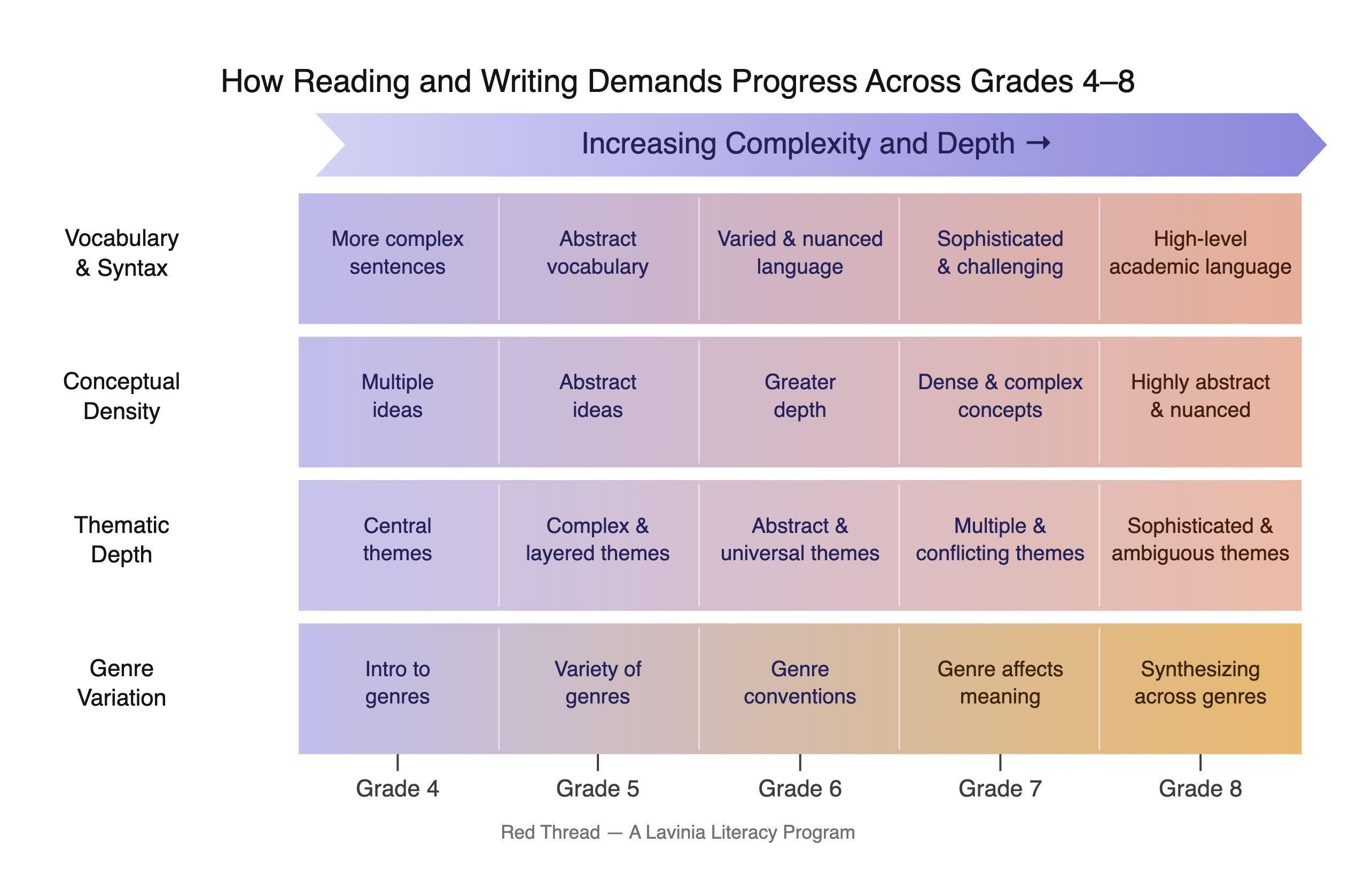
As a result, students are navigating more complex sentence structures, more abstract vocabulary, and more layered ideas, but without consistent opportunities to return to earlier moments in a text or to see how meaning develops across chapters. The demands increase, but the experience of reading does not always change in line with them.
Without that experience, reading can begin to feel fragmented and difficult to sustain. As Jillian explained:
“Texts are getting more complex. Tasks are getting more complex. And students need intentional support to grow alongside those demands.”
How Whole Books Strengthen Upper and Middle-Grade Literacy
When students spend time inside a full text, the work of comprehension begins to shift. Instead of responding to a single passage, they are asked to hold onto ideas, return to earlier moments, and notice how meaning develops across chapters.
You can see this in the way students start to talk about a book. A decision a character makes early on begins to feel more complicated later. A detail that seemed minor at first comes back with new significance.
Students begin to anticipate what might happen next, revise earlier interpretations, and connect moments that are pages apart, rather than treating each section as something separate.
Jillian pointed to this as one of the most important differences between excerpts and whole texts. When students stay with a book, they have the chance to follow ideas, characters, and themes across an extended arc. The work is no longer just identifying what is happening in a moment, but making sense of how that moment fits into something larger.
That sustained engagement also changes what students are able to do with their thinking. In a classroom built around a full text, writing becomes a continuation of reading.
Students return to earlier chapters, gather evidence across multiple moments, and use writing to clarify or reconsider their ideas. Joan Sedita of Keys to Literacy describes this as “thinking on paper,” a process that helps students organize and retain what they have read.
Over time, these experiences accumulate. Students develop the stamina to stay with a text, the knowledge to recognize how ideas connect, and the confidence to engage with increasingly complex material. What starts as following a story or argument becomes the ability to interpret, question, and build on it.
How RedThread Supports Whole Book Literacy
Coherence across grade levels is the result of intentional curriculum design, supported by professional learning and coaching that help teachers translate that design into daily instructional practice.
RedThread Literacy is built on the idea that students grow as readers when texts, tasks, and knowledge are deliberately developed over time. Rather than moving through isolated passages, students engage with complete books connected by meaningful themes and questions that extend across units and grades.
Within each grade level, lessons are structured to support the progression Jillian described during the webinar. Teachers model how skilled readers approach challenging texts, making their thinking visible. Students then apply those approaches with support before taking on more independent reading, building stamina and confidence through sustained engagement with a text.
As students move through the grades, both the texts and the work they are asked to do become more complex. In fourth grade, a student might trace how a character changes across a story. By eighth grade, that same student is evaluating sources, synthesizing ideas across multiple texts, and constructing an argument grounded in evidence.
Over time, these experiences begin to shape how students approach reading. They come to expect that understanding a text will take time, that it may require going back and reconsidering an earlier idea, and that their thinking can evolve as they gather more evidence. That sense of themselves as readers grows from the work they have done, not from a single moment of success.
If you want to see how this progression takes shape in classrooms, we invite you to explore sample RedThread units and instructional materials.

Three Ways Whole Books Strengthen Literacy Development
1. Whole Books Build Reading Stamina
When students read a full text, stamina is not just about reading for longer periods. It shows up in the kind of thinking the text requires.
A student must remember earlier moments, carry those forward, and reconsider them as the story or argument develops. A detail in chapter two may not seem important until much later. A character’s decision may only make sense when placed alongside earlier choices.
In classrooms, this changes the kinds of questions students are asked. Instead of “What happened in this section?” a teacher might ask, “How does this moment connect to what we noticed earlier?” or “Why does this decision matter now, given what we know from before?” Students begin to move back and forth through the text, rather than staying anchored to a single page.
That movement is what builds stamina. Students are learning to stay oriented within a text, hold multiple ideas at once, and adjust their thinking as those ideas evolve.
In RedThread units, this shows up in the design of prompts and tasks. Students are regularly asked to return to earlier chapters, gather evidence from different moments, and reconcile new information with what they previously understood. Over time, they become more comfortable with the feeling that understanding a text takes sustained attention, not just a quick read.
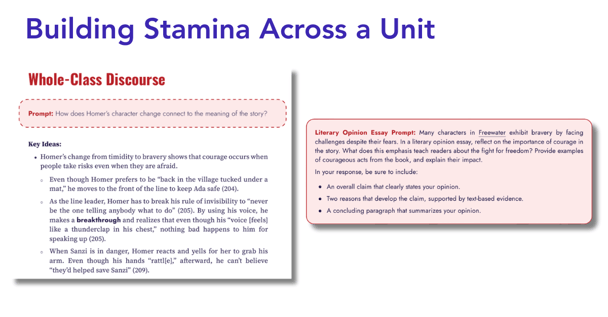
RedThread units include instructions and prompts that require students to integrate new information
and hold multiple ideas in working memory.
2. Whole Books Help Students Build Knowledge Over Time
A single extended text gives students the chance to develop knowledge in a way that feels connected rather than fragmented. As they move through a book, ideas are introduced, revisited, and expanded, and vocabulary returns in new contexts, allowing students to refine their understanding.
That experience begins to shape how students read beyond a single text. As they spend time following an idea across chapters, they become more prepared to carry that knowledge into new readings, recognizing when a topic or concept connects to something they have seen before.
In a text anchored in a topic like space, students might begin with basic ideas about planets or exploration, then encounter those ideas again in more complex contexts, such as scientific discoveries or the decisions behind the moon landing. When they later pick up a different text on a related topic, they are no longer starting from scratch, but building on a foundation they have already begun to form.
Because the ideas stay in play, students are building on what they read, carrying knowledge forward.

3. Whole Books Shape Reader Identity
Perhaps the most lasting effect of whole-book instruction is how students begin to see themselves. Finishing a challenging text is not a small moment. It changes what students believe they can do.
A student who has worked through a complex novel, returned to earlier chapters to make sense of it, and stayed with an idea across weeks of reading starts to approach the next text differently.
“By immersing students in whole books and treating reading as an end in itself, rather than a means of developing discrete skills… teachers can foster reading stamina, sustained focus, and intellectual curiosity that all students deserve to enjoy.”
Natalie Wexler, Author of The Knowledge Gap
In classrooms, this often shows up in small but noticeable ways. Students are more willing to go back and reread when something does not make sense. They are quicker to offer an interpretation, even when they are still working it out. They begin to expect that reading will take time and that their understanding will deepen as they stay with it.
Over time, those habits carry beyond a single unit or classroom. Students are more likely to return to reading on their own, not because they have been told to, but because they have experienced what it feels like to make meaning from a text that once felt out of reach.
Research-Based Literacy Strategies for Older Students
The webinar also highlighted several instructional practices supported by literacy research that improve outcomes for adolescent readers. Jillian focused on three approaches that consistently help students engage with complex texts and grow as readers.
Approach 1: Explicit Instruction
In a strong lesson, the teacher makes the work of reading visible. Rather than asking students to respond right away, the teacher models how a reader approaches a text, pausing to notice a word choice, question a claim, or connect one detail to another. Students then try that same work with support before taking it on more independently.
That progression, from modeling to guided practice to independence, allows students to see what skilled reading looks like and gives them a way to practice it in manageable steps. High-quality materials play an important role here, helping teachers surface those moments of thinking so students can follow the process and apply it themselves.
This approach is well supported by research. Guidance from the Institute of Education Sciences emphasizes the importance of “direct and explicit instruction in comprehension strategies,” including modeling, guided practice, and feedback as students learn to apply those strategies independently.
Institute of Education Sciences. Improving Adolescent Literacy: Effective Classroom and Intervention Practices. U.S. Department of Education.
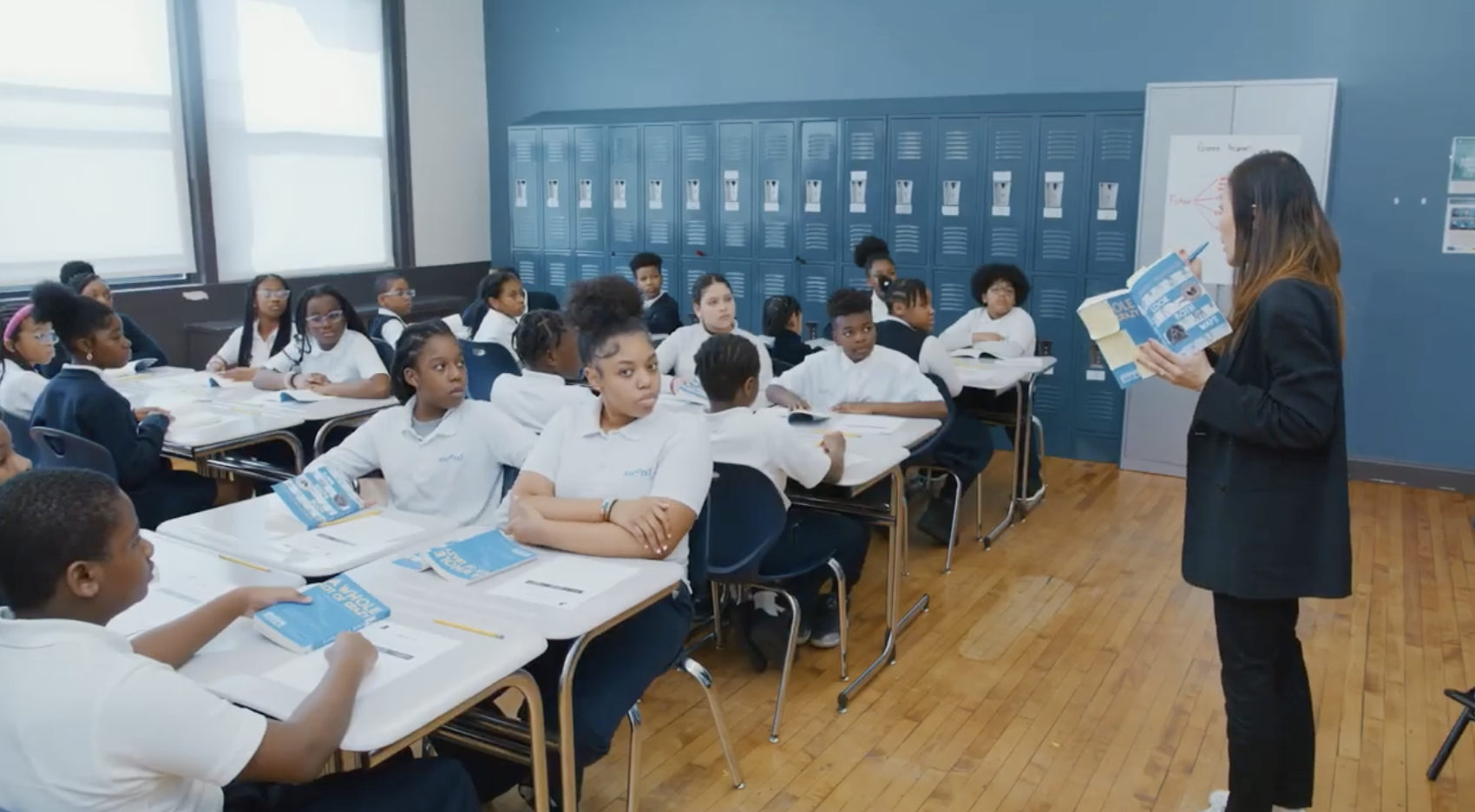 Senior Instructional Consultant Naeri Knox models how to guide students through deep literary analysis using Look Both Ways by Jason Reynolds.
Approach 2: Teaching Morphology to Expand Vocabulary
When students understand how words are built, vocabulary becomes something they can work through. Recognizing prefixes, suffixes, or roots gives them a way into unfamiliar words, allowing them to make sense of their meanings without relying on memorization alone.
A root like mal, for example, carries over into words such as malicious, malfunction, and malnutrition, giving students a foothold in each new context.
Jillian pointed out that this kind of instruction is especially important for multilingual learners and students who struggle with reading. Instead of encountering each new word as something entirely separate, students begin to notice patterns and apply what they know across texts.
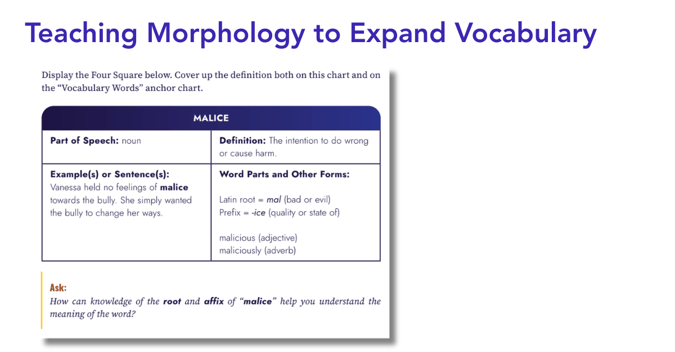
Over time, that shift changes how they approach reading. Vocabulary becomes something they can analyze and unpack, rather than something that interrupts their understanding.
Research supports this approach. Explicit morphology instruction has been shown to improve vocabulary and reading outcomes for secondary students, with particularly strong effects for English learners, students with disabilities, and struggling readers (Kamil et al., 2008; Goodwin & Ahn, 2010).
Approach 3: Structured Discussion to Strengthen Comprehension
Structured discussions such as Socratic seminars, partner talk, or text-based debates, give students space to test ideas, challenge interpretations, and build understanding together. Those conversations push them beyond surface-level comprehension.
In one seventh-grade RedThread lesson, a Socratic seminar is built around the question, “Why do people achieve different levels of personal success?” Students are asked to come prepared with ideas and evidence from the text, and the discussion is structured to help them listen, build on one another’s thinking, and consider multiple perspectives.
As the conversation unfolds, students return to specific moments in the text to support their claims. A student might point to a character’s decision in one chapter, only to have a peer bring in a different moment that complicates that interpretation. The teacher’s role is to press for precision, asking students to locate the passage that shaped their thinking or to respond directly to a classmate’s idea.
Alongside the discussion, students collect evidence and reflect on how their thinking is shifting, preparing to carry those ideas into writing. The conversation does not stand alone. It becomes part of a longer arc of thinking that moves from reading to discussion to written analysis.
Jillian described a moment from coaching a classroom discussion that stayed with her. After a seventh-grade class spent the period discussing complex historical ideas, one student said on her way out, “I really liked that class.”
That kind of response reflects the shift when students experience reading as thinking, and begin to see themselves as capable readers and contributors to the conversation.
Watch student discourse in action:
.png?width=600&height=400&name=Untitled%20design%20(28).png)
The Ultimate Goal of Literacy Instruction
Educators pay close attention to reading data, and for good reason. Those measures can show where students are growing and where they need support. But they do not fully capture what strong literacy instruction aims to achieve over time.
Jillian often returns to a different measure, one that is harder to quantify but easy to recognize in a classroom. She describes it as the moment when students begin to fall in love with reading through the books they experience, not because they are asked to, but because something in those texts stays with them.
Whole books create the conditions for that to happen. They give students time to live with ideas, to sit with unresolved moments, and to return to questions that do not have immediate answers. In a classroom reading a novel together, you might hear students debating a character’s decision days after first encountering it, or revisiting an earlier chapter to reconsider what they thought they understood.
As students move through a text in this way, they begin to notice patterns, wrestle with the choices characters make, and connect those ideas to their own experiences and to the world around them. Over time, reading becomes less about completing an assignment and more about engaging with ideas that continue to unfold.
Frequently Asked Questions About Whole Book Literacy Instruction
Why are whole books important for middle school literacy?
Whole books help students track themes, remember earlier events, and analyze complex ideas across chapters. These skills prepare students for high school and college-level reading.
Do whole books help struggling readers?
Yes. Whole books provide sustained opportunities for practice, vocabulary exposure, and comprehension development. With appropriate scaffolding, they can significantly improve reading stamina.
What happens to reading development after third grade?
Students encounter longer texts, advanced vocabulary, and deeper analysis tasks. Instruction must support this shift so students can move from basic decoding toward critical thinking and synthesis.
What role does reading identity play in literacy growth?
When students complete challenging books, they build confidence and begin to see themselves as capable readers. That identity often leads to more independent reading and stronger literacy outcomes.
Ready to See RedThread Literacy in Action?
If your school is working to strengthen reading in grades four through eight, it can help to see what this looks like in real classrooms and materials.
You can explore sample RedThread lessons to see how students work through full texts, return to earlier chapters, and build ideas over time.
If you are considering how this approach might fit within your school or system, our team is always glad to talk through what implementation might look like in practice.
Start by exploring the materials, or reach out to continue the conversation.
View by Topic
 Literacy Instruction
- Science of Reading
- Curriculum Implementation & Adoption
- Early Literacy
- Accelerated Learning
- Middle School Literacy
- News
- Professional Development
- Summer Learning Programs
- ESSR Funding
- School Improvement
- Summer School Curriculum
- Evidence-Based Math Strategies
- Instructional Coaching
- Professional Learning
- Summer Reading
- Teacher Recruitment & Retention
Subscribe to Our Blog
Recent Articles

How to Evaluate the Best K–8 Literacy Program for Your School
Most Literacy Curriculum Looks Similar on Paper
The best K–8 literacy programs do more than include phonics, vocabulary, writing, and knowledge-building. They create a coherent literacy curriculum...
How to Evaluate a K-8 Literacy Program Beyond the Buzzwords
Why Literacy Program Reviews Have Become More Complicated
When evaluating a K–8 literacy program, look beyond whether it includes phonics, vocabulary, writing, and knowledge-building. The...