
Building Teacher Expertise into Decision-Making
K12 Coalition Managing Director of District Services Dr. Andrea Thomas-Reynolds explores how district leaders can build teacher expertise into decision-making in a new article for The Learning...
Share Post


Whole books support stronger comprehension and engagement than disconnected excerpts because students must carry ideas across chapters, revisit earlier thinking, and build meaning over time. Excerpts can support skill practice, but when they dominate instruction, they limit students’ ability to develop sustained understanding and reading stamina.
Step into a typical upper-grade or middle-grade classroom during reading block, and you’ll often see students working through a short passage followed by a set of text-dependent questions. The next day brings a new excerpt, a new skill focus, and another contained task.
This structure mirrors assessment formats and keeps pacing predictable, which makes it appealing in busy classrooms. But with this shift towards curriculum built on text sets full of exclusively short texts, what have we given up when it comes to student experience?
Curriculum built around short texts can start to send students a quieter message, one that settles in over time. Students begin to decide whether they are capable of handling complex texts, whether stories are worth sustained attention, and whether their own thinking can stretch across chapters and still hold together.
When their experience is built mostly on brief, disconnected excerpts, they rarely experience the satisfaction that comes from staying with a text long enough to understand it deeply and wrestle with its ideas. Nor are they falling in love with reading in a way that will build lifelong engagement and learning.
That is where the difference between whole books and excerpts becomes more than an instructional decision. It shapes whether students leave school prepared to think deeply, read with confidence, and engage with the complex ideas that define college, careers, and civic life.
Full Books vs. Excerpts
Comprehension: cumulative vs. reset daily
Vocabulary: repeated exposure vs. isolated exposure
Engagement: sustained investment vs. task completion
Writing: multi-text evidence vs. single-passage response
Students develop deeper comprehension when reading full books because meaning builds across chapters, requiring them to track, revise, and connect ideas over time.
In grades four through eight, texts ask more of students. Ideas build across chapters, details accumulate, and meaning often depends on what came before.
You can see this when a class is partway through a novel. A student pauses and realizes that a character is growing and developing, maybe even taking inspiration from that growth for their own experience. Another revises an earlier interpretation after a new detail complicates what they thought they understood.
That kind of thinking depends on continuity. Students are holding onto ideas, returning to them, and adjusting them as they read.
When reading is built mostly on excerpts, that work resets each day. In our work with classrooms, we consistently see that students can answer comprehension questions accurately, but they are not asked to carry ideas forward or to notice how meaning develops across chapters, because the text rarely lasts long enough for that to happen.
In classrooms working through a whole book, you start to hear different kinds of questions. A teacher might ask, “How has your thinking about Jonas changed since the beginning?” and students begin reaching back across the text, pulling together moments from earlier chapters to support their thinking.
The work becomes cumulative, and students read with the expectation that what they encounter now will matter later.
.png?width=1344&height=740&name=Untitled%20design%20(27).png)
Whole books increase engagement because students spend enough time with characters and ideas to become invested in them. This sustained connection helps students see themselves as capable readers who can follow and interpret complex texts.
In middle school classrooms, it doesn’t take long to notice when students are (or are not) invested in a text. They begin predicting what might happen next. They question a character’s decision without being prompted. They reference earlier moments in conversation because those moments still feel present.
Following a character across an entire novel or tracing an argument through a full nonfiction text creates a different level of investment. Students begin to care about what happens because they have spent time with it. They begin to see patterns, tensions, and ideas that are not visible in a single passage.
Finishing a book carries a different weight than finishing a worksheet. It signals persistence and competence, especially with challenging texts.
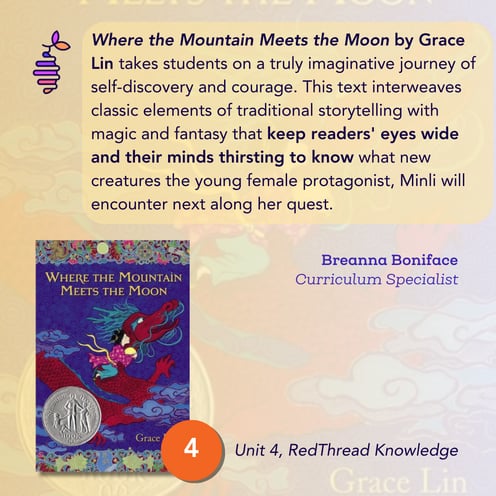 RedThread features whole texts that lend themselves to sustained thinking and discussion.
In classrooms where students regularly complete whole texts, you can see that shift. Students who once rushed through assignments begin to linger in discussions, referencing earlier chapters without being asked.
Jillian Roche, Director of Curriculum at Lavinia Group, described a moment after a seminar when a student lingered at the door and said, “I actually liked that class.” The conversation had been about a complex text, but what stayed with the student was the chance to think through it with others who had read the same book.
Writing shifts as well. Instead of responding to a single excerpt, students draw on a sequence of events or ideas. In a literary essay, a student might trace how a character’s understanding evolves across the text, pulling evidence from multiple chapters. That kind of writing depends on having something sustained to work with.
These experiences cultivate stamina, curiosity, and confidence, all of which influence long-term academic outcomes.
Instruction is best when organized around rich whole books that build knowledge. However, shorter texts have a role in curriculum. They can be used to build additional knowledge, extend thinking across a topic, and compare ideas across texts, in addition to targeted skill practice. A balanced approach ensures students develop both discrete skills and deep reading ability.
Short texts still have a place. They can introduce a topic, provide contrast, or allow students to practice a specific skill. But when they become the primary experience of reading, students have fewer opportunities to do the kind of thinking that complex texts require.
In the upper grades, students are asked to compare sources, evaluate arguments, and build their own ideas. That work develops more naturally when it is grounded in sustained reading. A full-length text gives students something to return to, question, and build on over time.
%20(Instagram%20Post).png?width=427&height=427&name=Untitled%20(380%20x%20200%20px)%20(Instagram%20Post).png) In RedThread classrooms, students move through whole books within a coherent sequence.
In RedThread classrooms, students move through whole books within a coherent sequence.
In RedThread classrooms, that sustained experience is intentional. Students move through whole books within a coherent sequence, returning to central ideas and vocabulary across chapters and across units. Writing and discussion are built directly from those texts, so that students are consistently asked to connect, revise, and extend their thinking.
Over time, the shift is noticeable. Students begin to read with the expectation that meaning unfolds. They return to earlier moments in the text on their own and start to trust that they can hold on to complex ideas and work through them.
That shift comes from giving students the experience of staying with something long enough for their thinking to grow.
Are whole books better than excerpts for reading comprehension?
Whole books generally support stronger comprehension because students must track ideas across chapters, revisit earlier information, and revise their thinking over time. Excerpts often limit this by resetting context with each new passage.
Do excerpts hurt student learning?
Excerpts are not inherently harmful to literacy instruction, but overreliance on them can limit opportunities for sustained thinking, deep comprehension, and knowledge building across a text, skills that are all necessary for college and career readiness.
When should teachers use excerpts instead of whole books?
Excerpts work well for targeted skill practice, introducing a topic, or comparing multiple perspectives. They are most effective when used alongside, not in place of, sustained reading of full texts.
How do whole books impact student engagement?
Whole books increase engagement by giving students time to invest in characters, follow storylines, and anticipate outcomes. This sustained connection leads to deeper participation and discussion.
Is it realistic to teach whole books in a standards-driven classroom?
Yes, but it requires intentional planning. Short texts can still support specific skills, while whole books provide the foundation for deeper comprehension, discussion, and writing.
What happens when students only read excerpts?
Students may become proficient at answering short, text-dependent questions but struggle to sustain understanding, connect ideas across texts, or engage deeply with complex material.

 Literacy InstructionScience of ReadingCurriculum Implementation & AdoptionEarly LiteracyAccelerated LearningMiddle School LiteracyNewsProfessional DevelopmentSummer Learning ProgramsESSR FundingSchool ImprovementSummer School CurriculumDistrict LeadershipEvidence-Based Math StrategiesInstructional CoachingProfessional LearningSummer ReadingTeacher Recruitment & Retention
K12 Coalition Managing Director of District Services Dr. Andrea Thomas-Reynolds explores how district leaders can build teacher expertise into decision-making in a new article for The Learning...
The best K–8 literacy programs do more than include phonics, vocabulary, writing, and knowledge-building. They create a coherent literacy curriculum...
