Share Post


In many classrooms, reading instruction helps students decode text, but not deeply understand it. A recent article in The 74 reports that, in four large urban districts, literacy instruction rooted in the science of reading may fall short of fostering deeper comprehension. The study found that while students are “grasping basic literacy skills,” many classrooms still lack what researchers call “robust comprehension.”
One of the most striking findings was that more than two-thirds of the observed comprehension lessons focused on “surface-level” understanding, and fewer than a quarter engaged students in deeper learning that required analysis, discussion, or interpretation of the text.
This suggests many students spend much of their reading time recalling details rather than building the habits of analysis, interpretation, and sustained thinking that complex texts demand.
These findings are particularly notable when compared with a recent report by Jill Barshay in the Hechinger Report showing that the “Mississippi Miracle” may not last into the upper grades, where comprehension requirements deepen. Barshay writes that for the fourth graders whose reading scores demonstrated such marked progress in the state, reaching eighth grade, “their progress stalled.”
Our experience in schools similarly reflects these findings. In many classrooms, even in the upper grades, we often see lessons centered on literal questions like “What is happening in the text?” While those questions can assess basic understanding, they keep the focus on surface-level comprehension.
Strong reading instruction requires more than decoding and recall. Students need regular opportunities to analyze ideas, interpret meaning, and engage in discussion to build true comprehension.
What happens when phonics instruction is disconnected from meaning?
This pattern points to a deeper issue in how foundational skills are being used in classrooms. The initial article from The 74 Million suggests that a phonics-based approach may unintentionally encourage teachers to focus on surface-level goals.
Researchers observed that foundational skills were often limited to reading single words rather than connected text, and that comprehension work frequently centered on completing tasks rather than building understanding.
This is concerning because if students are primarily labeling, identifying, and filling out graphic organizers, they are not developing the thinking required for long-term success. Explicit phonics and fluency instruction are essential; the issue arises when foundational skills become the ceiling rather than the floor.

How can decodable texts support both foundational skill building and comprehension?
One challenge in practice is that comprehension is often treated as something that comes later, after students have mastered decoding. In practice, strong literacy instruction does not separate those experiences. From the earliest grades, students can build knowledge, connect ideas, and make sense of the world through what they read.
The question is not whether young students are ready for knowledge building. It is whether the materials and instruction they experience make that possible.
Dan Reynolds in The 74 Million asks, “Are we teaching our K-4 kids that reading is just a task?”
That question resonates because we see it in classrooms. When early reading is reduced to word-level decoding and basic comprehension tasks with texts that do not allow for deep analysis and understanding, students may become accurate decoders, but they are not developing the critical thinking skills needed to use reading as a tool to make sense of the world.
Reading should open something up for students. It should give them a way to make sense of familiar experiences and begin to understand new ones. That shift is possible even when students are still learning foundational skills.
In Laundry Day, one of our decodable RedThread Readers, students practice targeted phonics patterns such as consonant digraphs.
Within the text, they encounter and decode words like shop, chat, mesh, and much. At the same time, they engage with a familiar, relatable experience: a child trying to solve a problem while helping his dad do the laundry.
As students read, they explore concepts such as problem-solving, perseverance, and innovation. They also build knowledge about the different ways laundry is done around the world and consider the unique challenges that may arise.
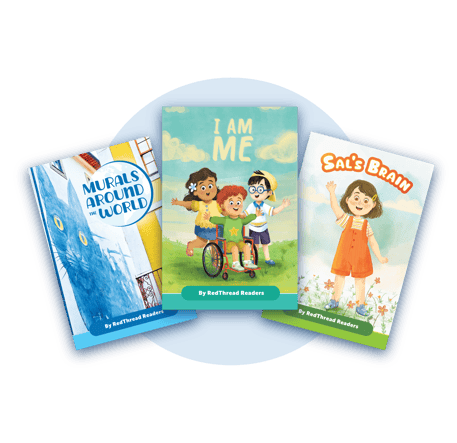 RedThread phonics decodables emphasize knowledge-building.
As students read, the words move beyond phonics patterns, and students begin to connect deeper meaning to the text, building their understanding of how the world around them works.
That understanding is often developed through rich discussions. A student might notice that Max keeps trying even when the task feels frustrating, and the teacher asks, “How does Max persevere to solve his problem?”
The text extends beyond the story. Students learn how people use problem-solving in their everyday lives and begin to make connections beyond their own personal experiences.
What they read is no longer limited to a single page or task. Instead, students build knowledge they can carry forward and apply in new contexts, giving the words they decoded a place within a broader understanding of the world.
Over time, those experiences change what reading feels like for students. Instead of moving from one isolated task to the next, they begin to expect that a text will give them something to think about, something to remember, and something to connect to the next thing they read.
Reading begins to carry meaning and purpose, and students start to experience the joy that comes from using reading to understand and engage with the world around them.
Why does comprehension break down in upper grades?
The article notes that districts had “done so much to get the kids all the way there [with literacy], but it was losing voltage in the end.”
That metaphor points to what is missing.
Foundational skills create access. They allow students to read words accurately and with increasing automaticity. But access alone does not ensure understanding. Without knowledge building, discussion, writing, and meaningful engagement with text, that early progress begins to stall.
If fewer than a quarter of observed lessons reflect robust comprehension, the issue may not be solely an implementation gap. In some cases, it reflects deeper questions about how we approach reading instruction and what we prioritize within literacy systems.
These patterns are not the result of individual teacher decisions alone. They are shaped by both high-quality curriculum design and the ways those materials are implemented, as well as the underlying beliefs about the role of comprehension, knowledge, and meaning in reading.
Closing that gap requires more than asking teachers to “go deeper.” It depends on high-quality curriculum design, coherent implementation, and aligned beliefs that make deeper thinking visible and attainable in daily instruction.
Teachers need opportunities to study texts in advance, anticipate how students might interpret a passage, and see how a question can move a student from recalling to explaining and analyzing.
They also need to practice these moves in real classrooms with support and closely examine student work to understand what is changing over time and where to prioritize their focus to best support student learning.
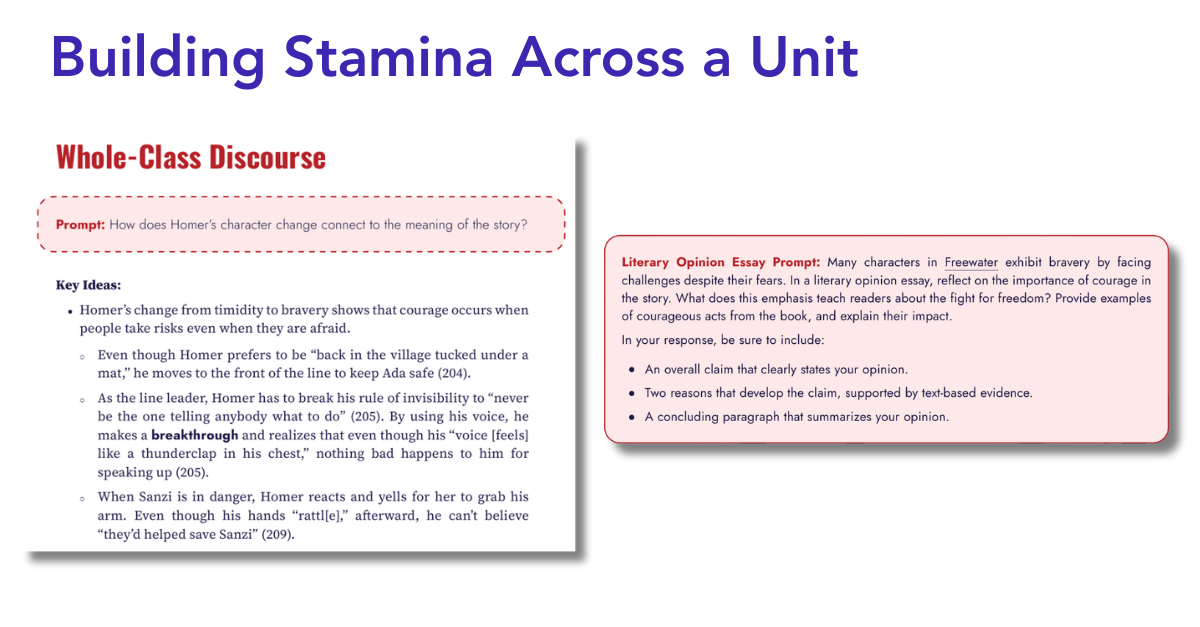
They also need a literacy curriculum that brings foundational skills and meaning-making together from the start. Texts should introduce ideas that build across lessons, and tasks should ask students to revisit those ideas, connect details, and explain their thinking using evidence from the text.
This is where the opportunity sits. Foundational skills give students access to the text, but access alone is not enough. What matters next is how we approach reading instruction—through high-quality curriculum design, aligned implementation, and a shared commitment to meaning and knowledge.
When these elements come together, students are not only able to read the words, but are expected to do something with them: to explain what a detail shows, to connect one part of a text to another, and to refine their thinking as they read.
Why isn’t reading instruction leading to deeper comprehension?
In many classrooms, students are taught to decode words and recall details, but not to analyze, interpret, or connect ideas across a text. When comprehension instruction focuses on surface-level questions and isolated tasks, students may read accurately without developing the thinking skills required to understand complex texts.
How can schools bridge the gap between decoding and understanding?
If you are wrestling with how to move from foundational skills to deep, knowledge-driven comprehension, we invite you to explore how RedThread is structured to do exactly that.
View the RedThread Foundations Scope and Sequence for K-2, where explicit phonics, decoding, fluency, and morphology are taught systematically and connected to knowledge-building and meaningful text.
Then explore the RedThread Knowledge Building Scope and Sequence for K-5, which uses whole books, authentic texts, integrated writing, structured discourse, and project-based learning to build the background knowledge and comprehension students need for long-term success.
Discover how RedThread Literacy aligns to the science of reading and translates decades of research and classroom practice into a program that builds achievement, curiosity, and a lasting love of learning.

View by Topic
 Literacy Instruction
- Science of Reading
- Curriculum Implementation & Adoption
- Early Literacy
- Accelerated Learning
- Middle School Literacy
- News
- Professional Development
- Summer Learning Programs
- ESSR Funding
- School Improvement
- Summer School Curriculum
- Evidence-Based Math Strategies
- Instructional Coaching
- Professional Learning
- Summer Reading
- Teacher Recruitment & Retention
Subscribe to Our Blog
Recent Articles

How to Evaluate the Best K–8 Literacy Program for Your School
Most Literacy Curriculum Looks Similar on Paper
The best K–8 literacy programs do more than include phonics, vocabulary, writing, and knowledge-building. They create a coherent literacy curriculum...
How to Evaluate a K-8 Literacy Program Beyond the Buzzwords
Why Literacy Program Reviews Have Become More Complicated
When evaluating a K–8 literacy program, look beyond whether it includes phonics, vocabulary, writing, and knowledge-building. The...