Building Teacher Expertise into Decision-Making
K12 Coalition Managing Director of District Services Dr. Andrea Thomas-Reynolds explores how district leaders can build teacher expertise into decision-making in a new article for The Learning...
Share Post


Across the country, educators are searching for ways to improve math outcomes. New programs, new materials, and new initiatives often promise the next breakthrough. But the reality is simpler: we do not need the next shiny object in math instruction. Research tells us what works.
How We Solve America’s Math Crisis: A Systemwide Approach to Evidence-Based Math Learning, developed by K12 Coalition in partnership with Bellwether, highlights what happens when schools align their systems around proven instructional practices.
These gains came from aligning systems around three research-backed priorities that improve math outcomes:
First, math identity matters. Students and educators need to believe that math is accessible, that ability grows with effort, and that mistakes are part of learning. When students see themselves as capable mathematicians, they are more likely to persist through challenges and engage deeply with mathematical ideas.
Second, conceptual understanding and procedural fluency must grow together. Students need to understand why math works and build the skill to apply it accurately. One without the other leaves gaps that widen over time.
Third, learning must be logical and cumulative. Math builds, and each concept rests on the one before it. When instruction skips foundational ideas or moves out of sequence, students lose coherence, and confusion compounds.
These elements require systems that support teachers through aligned curriculum, strong professional learning, collaborative planning time, and a clear instructional vision.
Meaningful gains in math outcomes are possible when school systems align around these principles. Among New York City charter schools partnering with Lavinia Group, math proficiency increased by an average of 13 percentage points on the New York State assessment after the first year of implementation, with gains continuing in subsequent years.
When math identity, instructional practice, and coherent learning progressions work together, students are far more likely to experience mathematics as something they can understand, use, and succeed in.

Mathematics proficiency extends beyond executing procedures. It includes conceptual understanding, strategic competence, adaptive reasoning, and what the National Research Council calls productive disposition.
Productive disposition refers to seeing mathematics as sensible, worthwhile, and achievable through sustained effort. In instructional terms, this is math identity.
It is the quiet belief that says, “I can figure this out,” the understanding that confusion is temporary, and the willingness to stay with a problem long enough to make sense of it.
When students internalize the belief that they are not “math people,” they disengage from challenging work. They hesitate to explain their thinking, and they interpret mistakes as evidence of inability rather than as part of the learning process.
The same dynamic plays out for adults. When educators lack confidence in their own conceptual understanding, instruction narrows. Lessons tilt toward speed and answer-getting, rich discussions shrink, and reasoning gives way to procedures that feel safer to teach and easier to assess.
Math identity is the soil where intellectual rigor takes root. Without it, even well-designed tasks struggle to flourish. With it, students persist longer, explain more clearly, and begin to see themselves as capable mathematical thinkers.
If we want classrooms where reasoning thrives, we must first build environments where belief thrives.
.png?width=431&height=225&name=Lavinia%20Blog%20Post%20Callouts%20(4).png)
The report outlines clear instructional moves that strengthen math identity in daily practice.
Teachers surface misconceptions and ask, “Why might that strategy make sense?” Students revise publicly. They refine their thinking, and they see that understanding grows through iteration.
Over time, this normalizes struggle and lowers math anxiety. Students build resilience when they learn that being wrong is part of being mathematical.
Instead of celebrating who finishes first, teachers press for explanation and justification. Students are asked why an answer works and whether a method would apply in other contexts. This shift from quick responses to deep thinking strengthens understanding and confidence.
Students are given space to grapple with the material independently before formal modeling. Their strategies are surfaced, compared, and refined.
When students see their own thinking represented on the board, they begin to see themselves as contributors, and this powerful shift builds confidence.
Mathematical identity strengthens when students talk through mathematics out loud and when teachers facilitate conversations that promote clarity and reasoning. As a result, mathematics becomes about thinking and sense-making instead of memorization.
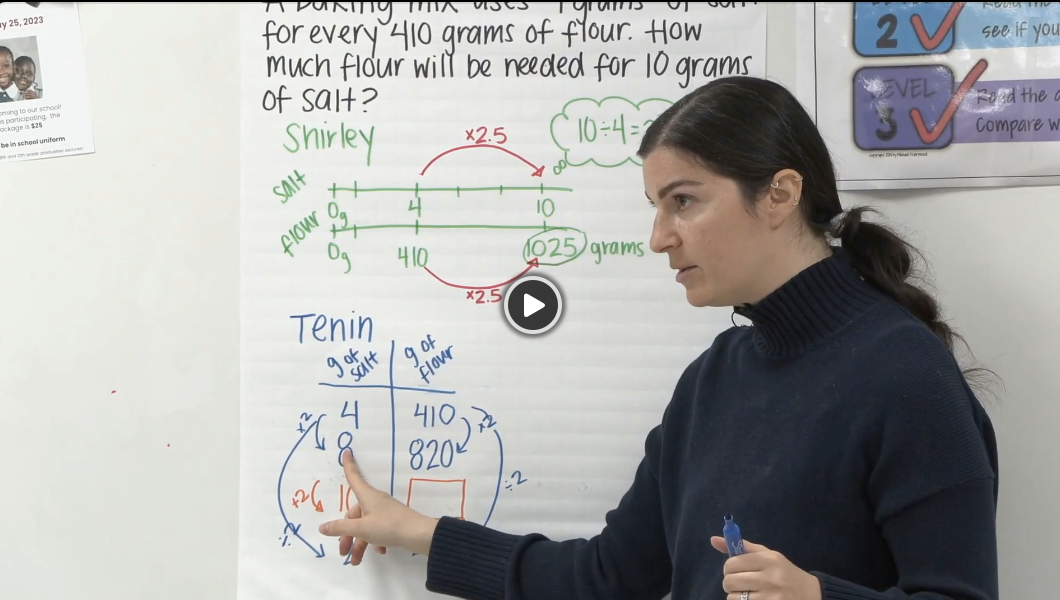
Many teachers were taught mathematics as a series of procedures to memorize and replicate. They learned how to get the answer, but they were rarely invited to explore why it works.
Without sustained professional learning that deepens conceptual understanding, it becomes difficult to facilitate reasoning-rich instruction with confidence. When teachers feel unsure of the underlying mathematics, classroom discourse often narrows. Lessons drift toward speed and answer-getting because it feels safe.
The report recommends math-specific professional development, ongoing coaching, and structured collaboration centered on student thinking. A key structure highlighted is Intellectual Preparation, in which teachers clarify the mathematical goal of a lesson, anticipate misconceptions, and plan questions that press for reasoning.
When teachers are grounded in the mathematics they teach and prepared to navigate student thinking in real time, mistakes become opportunities and meaningful discourse becomes daily practice.
For instructional coaches and principals, this reframes the work. The question is not simply whether standards are covered. The question is whether instructional conditions support reasoning and persistence.
Leaders can:
Create Space for Reflection
Provide structured opportunities for teachers to reflect on their own math experiences and how those experiences shape instruction.
Deepen Content Understanding
Invest in professional learning that builds conceptual understanding.
Normalize Growth
Cultivate a culture where teachers feel safe asking questions, testing strategies, and refining practice.
Prioritize Collaborative Learning
Protect time for teachers to analyze student thinking and strengthen instructional decision-making together.
Identity shifts when teams talk explicitly about math culture.
If your team is ready to begin this work, consider starting with a structured conversation about math culture and identity with a team of educators at your school. Our team is here to help you prepare for this conversation.

The whitepaper highlights Lavinia Group’s instructional support model as an example of how systems translate research into daily practice.
Teachers engage in focused planning that clarifies mathematical goals, anticipates misconceptions, and rehearses questioning strategies. Rather than responding to confusion in the moment without a clear plan, teachers enter the classroom prepared to guide student thinking with intention and confidence.
In many classrooms, misunderstandings are quickly corrected so the lesson can move forward. In this model, they are anticipated and used strategically. RedThread Mathematics lessons intentionally surface common misconceptions and provide teachers with guidance on how to explore them productively.
.png?width=1200&height=627&name=Lavinia%20Blog%20Post%20Callouts%20(6).png)
In RedThread Mathematics, lesson materials intentionally surface common misconceptions and provide teachers with guidance on how to use them to deepen conceptual understanding, rather than quickly correcting and moving on.
Teachers participate in a structured coaching rhythm that includes intellectual preparation, in-class modeling or feedback, and post-lesson analysis of student work. Debrief conversations center on evidence of student thinking and the instructional moves that either strengthened or limited understanding. Over time, this cycle builds precision in both planning and delivery.
Teachers regularly analyze students' reasoning together, identify patterns across classrooms, and share strategies to press thinking forward. This shared examination of practice strengthens both content knowledge and instructional confidence, ensuring that growth is collective rather than isolated.
The results of this work are measurable. Schools partnering with Lavinia Group have shown significant gains in math proficiency across starting levels. Schools beginning below 20 percent proficiency improved by nearly 19 percentage points in one year, with measurable growth across all baseline bands.
When math identity is strengthened through intentional professional development and sustained instructional support, student achievement follows. Belief is built through preparation, reinforced through practice, and sustained through systems that support both teachers and students every day.
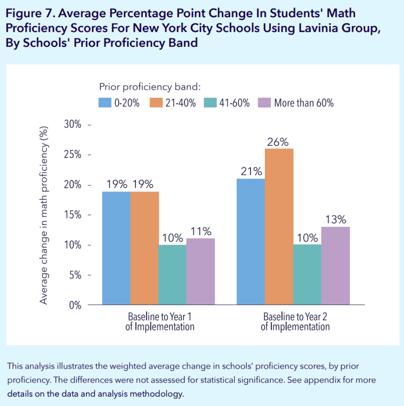
Data analysis shows that schools receiving Lavinia Group support made progress regardless of their starting point (Figure 7).
After a year of professional development, schools with baseline proficiency rates below 20% improved by an average of 18.9 percentage points, while those beginning between 21% and 40% increased by 19.3 percentage points.
Even schools at higher proficiency levels experienced significant growth, with gains of 9.8 percentage points among schools starting at 41% to 60% and 10.8 percentage points among those above 60%.
We have a research-backed roadmap for improving instruction. But the first step is belief.
When students believe they can do math, they stay with the problem longer. They explain their thinking, and they leverage mistakes as opportunities for deeper learning.
When teachers believe they can lead rich mathematical thinking, instruction becomes more ambitious, questions go deeper, and discourse expands.
When systems intentionally build cultures that support reasoning, collaboration, and productive struggle, improvement stops feeling accidental, and it becomes measurable.
Math achievement rises when belief is built into policy, when culture is reinforced through daily practice, and when identity is treated as infrastructure.
 Literacy InstructionScience of ReadingCurriculum Implementation & AdoptionEarly LiteracyAccelerated LearningMiddle School LiteracyNewsProfessional DevelopmentSummer Learning ProgramsESSR FundingSchool ImprovementSummer School CurriculumDistrict LeadershipEvidence-Based Math StrategiesInstructional CoachingProfessional LearningSummer ReadingTeacher Recruitment & Retention
K12 Coalition Managing Director of District Services Dr. Andrea Thomas-Reynolds explores how district leaders can build teacher expertise into decision-making in a new article for The Learning...
The best K–8 literacy programs do more than include phonics, vocabulary, writing, and knowledge-building. They create a coherent literacy curriculum...
