Share Post


Why Literacy Program Reviews Have Become More Complicated
When evaluating a K–8 literacy program, look beyond whether it includes phonics, vocabulary, writing, and knowledge-building. The strongest programs create a coherent student experience where reading, writing, discussion, and knowledge accumulation work together to develop increasingly sophisticated readers.
Evaluating literacy curriculum has become both more important and more difficult for district leaders.
A decade ago, curriculum conversations often centered on standards alignment, instructional materials, or teacher preference. Today, nearly every literacy program includes explicit phonics instruction. Many describe themselves as knowledge-building, and most include writing, vocabulary, and complex texts. On paper, the differences can seem surprisingly small.
The challenge is that features alone do not tell us what students will experience. The real work of curriculum evaluation is understanding how those features come together through the texts students read, the questions they discuss, the writing they do, and the ideas they revisit over time.
From a curriculum review perspective, those differences can be easy to miss. But they shape what reading becomes for students. They determine whether students are primarily completing literacy tasks or using reading and writing to build knowledge, make meaning, and think about increasingly complex ideas.
Look Beyond Curriculum Features
One pattern we frequently see in schools is that curriculum conversations begin with features. Committees look for phonics, decodables, writing assignments, and vocabulary instruction.
Those are all reasonable places to start, but they do not always help us understand what students will actually spend their time doing.
A curriculum is ultimately more than a collection of components. It is a sequence of decisions about what students read, write, discuss, and are asked to think about over time. The most important question is not whether a program contains particular features. It is whether those features work together to help students build knowledge, make meaning, and develop as readers.
That challenge is one of the reasons we created RedThread. As former teachers, school leaders, and curriculum designers, we wanted to build the kind of literacy curriculum we often found ourselves searching for in schools: one that treats foundational skills, knowledge-building, reading, writing, and discussion as interconnected parts of literacy development rather than as separate initiatives.
We want students to read whole books, grapple with meaningful questions, build knowledge over time, and use writing to deepen their understanding of texts.
Recently, The Reading League's Curriculum Navigation Report provided an independent review of RedThread's design, highlighting strengths such as explicit instruction in phoneme-grapheme correspondences, morphology, syllabication, and word reading.
While The Reading League is clear that its reports are not endorsements, they offer district leaders a useful opportunity to look beyond publisher claims and examine how research-informed principles appear in actual curriculum materials.
.png?width=357&height=357&name=Reading%20League%20%232%20(2).png)
RedThread Literacy was among the programs reviewed, with 72 of 74 indicators scoring a 1 or 2, indicating no evidence or minimal evidence of red flags.

Examine the Thinking Students Are Asked to Do Through the Literacy Curriculum
In many classrooms, students successfully answer questions about what happened in a text. They can identify details, recall information, and complete assigned tasks. Yet when asked to explain what those details reveal about a character, how an idea develops across chapters, or why an author made a particular choice, the conversation often becomes much more challenging.
The issue is not necessarily that students lack skills. More often, the curriculum has not consistently required that kind of thinking.
When district teams examine literacy materials, one useful lens is to look closely at the questions students encounter throughout a unit. Are students primarily being asked to locate information? Or are they being asked to interpret, connect, and revise their understanding as they read?
The difference becomes visible surprisingly quickly.
Consider a novel study in which students spend several weeks reading a text together. In one classroom, students complete chapter summaries and answer comprehension questions focused on plot. In another, students return repeatedly to a central question about how a character changes over the course of the novel. Early discussions focus on specific moments. Later conversations ask students to connect those moments across chapters and consider what they reveal about the book's larger themes.
Both classrooms are reading the same text, and both students may be able to recount what happened, yet the intellectual work is fundamentally different.
Evaluate How Knowledge Builds Over Time in a Literacy Program
The same principle applies to knowledge building.
Many literacy programs now organize instruction around topics, but topic-based instruction is not necessarily the same thing as knowledge building. What we consider more important is whether ideas accumulate.
We often see students spend several weeks on a topic before moving on to something entirely unrelated. As a result, vocabulary, concepts, and historical context disappear just as students are beginning to develop familiarity with them.
In stronger curricular sequences, knowledge has a chance to grow. Students encounter related ideas across multiple texts and contexts. Vocabulary reappears often enough to become useful. New learning attaches to prior learning rather than replacing it.
By the time students encounter increasingly complex texts in the upper grades, they are not approaching them empty-handed. They bring years of accumulated knowledge that helps them make sense of what they are reading.
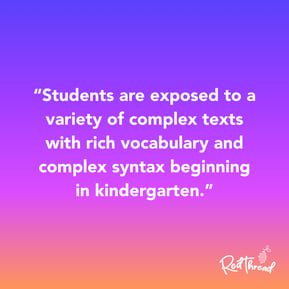
The Reading League's Curriculum Navigation Report highlights RedThread’s intentional text selection.
What District Leaders Should Look For When Evaluating Literacy Curriculum
Independent reviews can help districts move beyond marketing language and examine how programs approach foundational skills, language development, comprehension, and knowledge building.
Tools such as The Reading League's Curriculum Navigation Reports help districts move beyond marketing language and examine how programs actually approach foundational skills, language development, comprehension, and knowledge building. They provide a framework for asking deeper questions about instructional design rather than relying on claims alone.
Evaluation teams can also take a close look at the experience students will have:
- When students open a book, what will they be asked to notice?
- When they participate in a discussion, what kinds of ideas will they wrestle with?
- When they write, will they be assembling information or developing understanding?
Ultimately, district leaders are evaluating whether the pieces of the curriculum work together to create the conditions for students to become thoughtful, knowledgeable, and increasingly independent readers.
View by Topic
 Literacy Instruction
- Science of Reading
- Curriculum Implementation & Adoption
- Early Literacy
- Accelerated Learning
- Middle School Literacy
- News
- Professional Development
- Summer Learning Programs
- ESSR Funding
- School Improvement
- Summer School Curriculum
- Evidence-Based Math Strategies
- Instructional Coaching
- Professional Learning
- Summer Reading
- Teacher Recruitment & Retention
Subscribe to Our Blog
Recent Articles

How to Evaluate the Best K–8 Literacy Program for Your School
Most Literacy Curriculum Looks Similar on Paper
The best K–8 literacy programs do more than include phonics, vocabulary, writing, and knowledge-building. They create a coherent literacy curriculum...
How to Evaluate a K-8 Literacy Program Beyond the Buzzwords
Why Literacy Program Reviews Have Become More Complicated
When evaluating a K–8 literacy program, look beyond whether it includes phonics, vocabulary, writing, and knowledge-building. The...