
Share Post


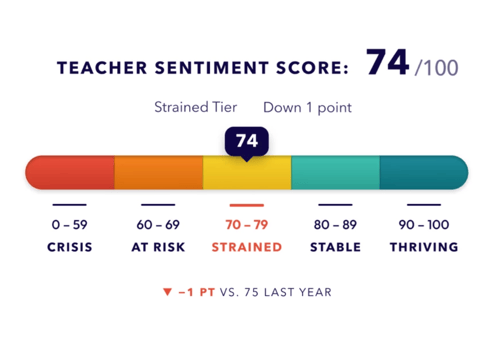
This year's Teacher Sentiment Score came in at 74 out of 100, down just one point from last year’s report by K12 Coalition. On paper, that doesn't look like a crisis. Many district leaders have seen larger swings in other measures.
But one pattern in this year's data deserves a closer look: beneath that relatively stable score, several indicators moved in the wrong direction simultaneously. Retention risk crossed 50 percent. The share of educators who describe themselves as "very satisfied" fell sharply. Workload pressures increased. Elementary educators reported some of the most concerning shifts in the survey.
In many districts, this is what the most dangerous phase of a staffing challenge looks like.
The system is not breaking loudly; it’s eroding quietly.
The Illusion of Stability
One of the most striking findings in the report isn't the number of teachers planning to leave, it's the number who aren't sure they'll stay.
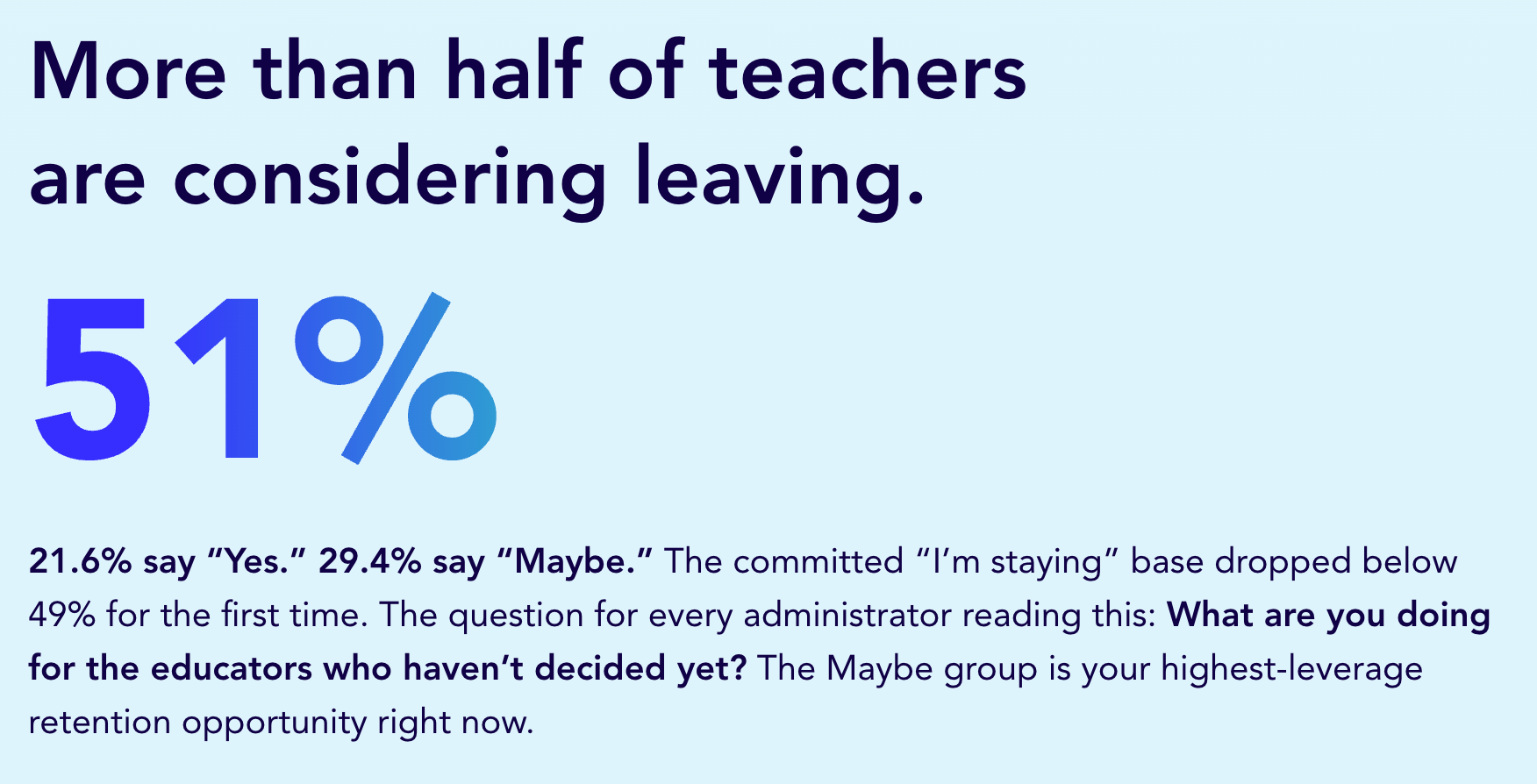
More than half of surveyed educators now fall into the "Yes" or "Maybe" categories when asked whether they are considering leaving the profession within the next two years. At the same time, the group firmly committed to staying shrank by nearly five percentage points.
For superintendents, that's a meaningful shift.
Most districts can absorb a certain amount of turnover. What becomes much harder to manage is growing uncertainty across the workforce.
When fewer educators can confidently picture themselves remaining in the profession, staffing challenges become less predictable.
The Real Crisis Is Workload, Not Morale
When educators were asked why they are considering leaving, workload remained the top reason. Salary was important, but workload ranked higher.
Too often, retention conversations become discussions about motivation, resilience, or culture. Yet the comments throughout the report tell a different story.
Teachers describe spending more time managing behavior, completing paperwork, and responding to expanding responsibilities than they do teaching. One elementary educator summarized it this way:
"The actual teaching is about 40% of what we are required to do."
In many districts, this points to an operational challenge more than a motivational one.
Teachers are not necessarily asking leaders to inspire them; they are asking leaders to remove obstacles.
At Lavinia Group, we often see districts respond to retention challenges by adding programs, committees, or initiatives to support staff. The intention is good, but the result is added complexity.
As Jason Stricker, Chief Policy Officer at K-12 Coalition, frequently notes, many of the pressures educators experience are not individual challenges to solve; they're system challenges to redesign.
When workload becomes the top reason teachers consider leaving, the question shifts from "How do we help teachers do more?" to "How do we build systems that require less?"
The Foundation Is Under Pressure
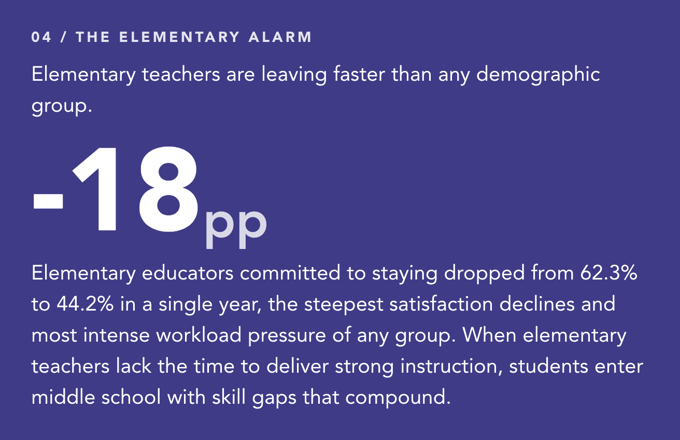
The report’s findings for elementary educators may be the clearest warning sign.
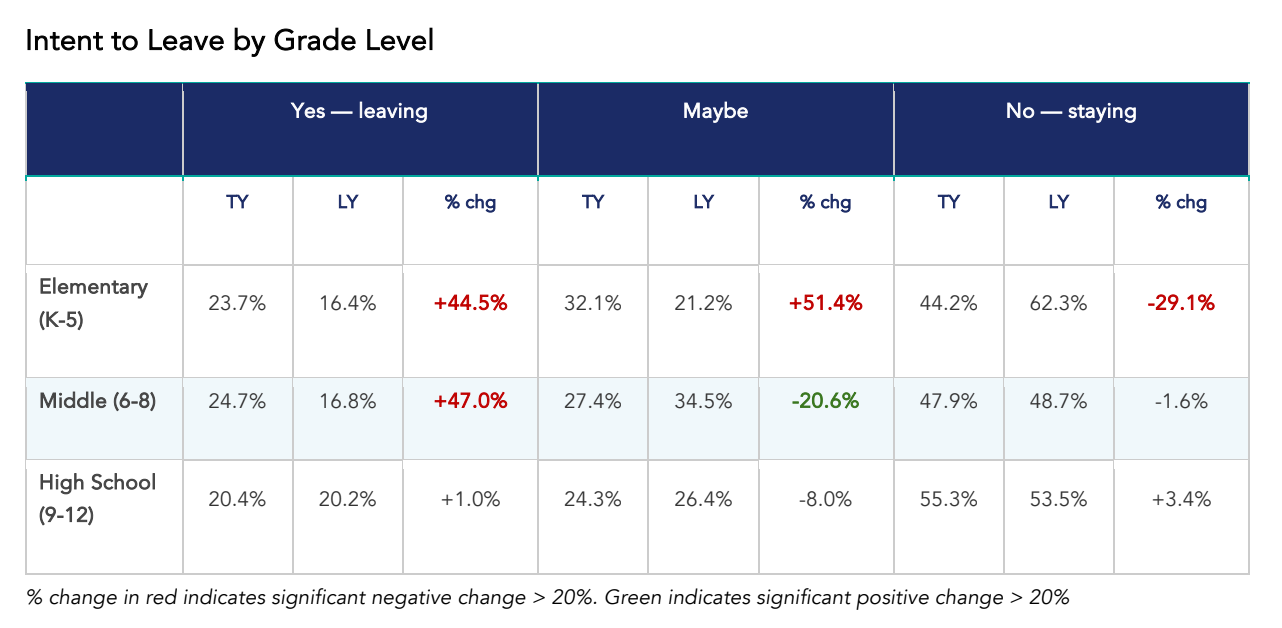
Elementary educators reported some of the highest levels of attrition risk, with more than half indicating they are considering leaving or are uncertain about staying.
This is significant because elementary schools are where districts build stability.
When K–5 staffing becomes unstable, districts begin to feel the effects everywhere else: substitute shortages increase, intervention systems become harder to maintain, and leadership teams spend more time filling positions than improving instruction.
Elementary educators are also navigating many of the challenges that surfaced throughout the report:
- Student behavior remains the most commonly cited challenge.
- Student mental health concerns continue to rise.
- Workload pressures are increasing.
- Additional responsibilities continue to expand beyond classroom instruction.
For district leaders, this may require a willingness to concentrate resources rather than distribute them evenly.
Elementary schools often serve as the earliest indicator of broader system stress.
The "Maybe" Teachers Are Your Biggest Opportunity
One of the most important findings in this year's report isn't the number of teachers planning to leave. It's the growing number who haven't decided whether they'll stay. Those educators represent both a warning sign and an opportunity: a signal that many retention decisions have yet to be made.
The 31–40 age group now represents the largest pool of educators answering "Maybe" when asked whether they plan to remain in the profession. Meanwhile, educators aged 41–50 experienced one of the sharpest declines in satisfaction.
These are not early-career teachers still deciding whether education is right for them. They are future principals, department chairs, instructional leaders, and mentors.
When districts lose this group, they lose both staff and leadership capacity. The encouraging news is that the report also points toward an opportunity.
We view the growth of the "maybe" category as an organizational signal. When large numbers of educators are undecided about their futures, districts still have time to act, but leaders need to understand what is driving that uncertainty before it leads to attrition.
Strategic planning creates the space to ask those questions systematically:
- What pressures are creating the most frustration?
- Which concerns are isolated to individual schools, and which reflect broader system issues?
- Where should leaders focus first to improve educators' daily experience?
By the time teachers have fully decided to leave, many opportunities for intervention have already passed. The "maybe" group gives districts a chance to respond earlier.
When educators were asked whether additional investment in their growth would make them more likely to stay, the percentage answering "No" dropped significantly, while the "Unsure" group grew.
That suggests many educators have not made a final decision; they're still evaluating whether they can see a future in the profession. The educators in the middle are often the ones districts can still retain, if they act on the conditions driving that uncertainty.
Strategic Planning Is a Retention Strategy
One pattern we see across many districts is that leaders are responding to multiple urgent challenges simultaneously. Every issue feels important, which can make it difficult to determine where to focus attention and resources first.
The value of a strong strategic planning process is that it helps districts move from reacting to every pressure point to identifying the handful of priorities that will have the greatest impact on teachers' daily experience.
The strongest strategic plans create clarity around a few critical questions:
- What are the biggest pressures facing our educators?
- Which challenges require system-level solutions rather than individual effort?
- Where should resources be concentrated first?
- What can we stop doing?
- How will we know whether conditions are improving?
Without that clarity, districts often end up launching multiple disconnected initiatives that create even more complexity.
With it, leaders can focus attention, resources, and communication on the issues teachers are actually raising.
.png?width=414&height=216&name=Lavinia%20Blog%20Post%20Callouts%20(8).png)
Strategic planning is often viewed as an exercise in setting goals, but we see its greatest value in maintaining focus.
As Jason Stricker, Chief Policy Officer, recently shared, our team evaluates major decisions through the lens of the instructional core: the relationship between the teacher, the student, and the content.
When districts face competing demands, staffing challenges, budget pressures, behavior concerns, new initiatives, or shifting policy expectations, strategic planning helps leaders identify which actions will strengthen that core and which may unintentionally pull attention away from it.
Without that discipline, districts can find themselves solving symptoms while the root causes remain unchanged.
Download the Report or Continue the Conversation
The findings in this year's report suggest that many educators have not yet made a final decision about whether to stay or leave. For district leaders, that may be the most important finding of all. It means there is still time to act, but action requires clarity, focus, and a plan.
Download the full Teacher Sentiment Report to explore the data in greater detail and understand how trends vary across educator groups and regions.
Or, if your district is beginning strategic planning work for the coming year, schedule a complimentary conversation with our team.
We'll share how districts are using strategic planning to identify root causes, align priorities, and create practical action plans that respond to what educators are saying today.

View by Topic
 Literacy Instruction
- Science of Reading
- Curriculum Implementation & Adoption
- Early Literacy
- Accelerated Learning
- Middle School Literacy
- News
- Professional Development
- Summer Learning Programs
- ESSR Funding
- School Improvement
- Summer School Curriculum
- Evidence-Based Math Strategies
- Instructional Coaching
- Professional Learning
- Summer Reading
- Teacher Recruitment & Retention
Subscribe to Our Blog
Recent Articles

How to Evaluate the Best K–8 Literacy Program for Your School
Most Literacy Curriculum Looks Similar on Paper
The best K–8 literacy programs do more than include phonics, vocabulary, writing, and knowledge-building. They create a coherent literacy curriculum...
How to Evaluate a K-8 Literacy Program Beyond the Buzzwords
Why Literacy Program Reviews Have Become More Complicated
When evaluating a K–8 literacy program, look beyond whether it includes phonics, vocabulary, writing, and knowledge-building. The...